
Simple, Advanced, Complex: reasoning and effort required according to the lawyer’s judgment
Inventum P5
Engineering · Galictis-Legal
October 7, 2026
9 min read
Using the most powerful model for every question isn’t advisable, and for routine work it isn’t necessarily what is needed. Nammu offers three operating modes in its conversational agent (Chat): Simple, Advanced and Complex. Each one has its own select group of AI models. This post describes what they are, how to use them and their benefits.
Operating Modes of the Conversational Agent (Chat)
| Cluster | Built for | Typical model profile |
|---|---|---|
| Simple | Summaries, issue tagging, data extraction, short factual chat | Fast and inexpensive; strong at structured output |
| Advanced | Deeper chat, long expedientes, research within one jurisdiction, larger matters | Strong reasoning and long context without flagship pricing |
| Complex | Very deep reasoning, very long context, what-if scenarios, jurisprudence analysis | The highest-scoring legal models available |
We implemented these operating modes based on market studies of AI in the legal context (see the article Reading legal AI leaderboards as a Costa Rican lawyer).
The rule: risk, not length
A 300-page expediente summary is Simple work, because a lawyer checks it against the original file (verification). A one-line question like “is my plazo to appeal still open?” might not be Simple. If the answer is confidently wrong, the right to act is lost, possibly irrevocably.
Two consequences follow:
- Calculations belong in Complex. Liquidación figures (preaviso, cesantía, proportional vacaciones and aguinaldo), procedural deadline arithmetic and the amounts in a multi-year divorce or pensión can be very hard to get right: long salary histories, changing rules, several components that interact. A wrong figure is as irreversible as a wrong deadline, so the work goes to the strongest cluster. Even there, treat the result as a draft. Ask the model to show its inputs (hire date, salary history, notification date) and its arithmetic step by step, then recompute the figure independently before it leaves your office. Our labor-law advisors warned that a model that “calculates” cesantía with no visible working is “the labor equivalent of a citation hallucination.”
- Some tasks are Complex no matter how short they are. These include anything that cites or describes a Sala’s criterio, prescription and caducidad, admissibility of a recurso, complex amount calculations, and any what-if that changes a strategy.
The following is a matrix of examples of judicial branch versus operating modes, which can help the lawyer optimize and tailor the experience with Nammu.
| Practice area | Simple | Advanced | Complex |
|---|---|---|---|
| Civil (CPC, Ley 9342) | Summarize a demanda or resolución; build the chronology of notificaciones | Cross-document inconsistencies; first outline of a contestación | Prescripción (term, start, interruption); monitorio vs. ordinario what-ifs; casación before Sala Primera |
| Contencioso-administrativo (CPCA, Ley 8508; LGAP, Ley 6227) | Summarize an acto administrativo; tag competence, procedure and motivación issues | Matching the claim to the process type and caducidad window; recursos in public procurement (Ley 9986) | Nulidad analysis; medidas cautelares; state liability |
| Labor (Ley 9343) | Summarize a demanda; build a timeline from payslips | Oral-hearing preparation; reconciling years of salary history | Fueros (maternity, union); despido with or without employer liability what-ifs; Sala Segunda trends |
| Family (Ley 9747, Ley 7654, Ley 7586) | Expediente chronology; extracting amounts and dates | Multi-year divorce plus liquidación de gananciales; income vs. evidence in a pensión | Custody and relocation what-ifs; interés superior; a domestic-violence measure running in parallel |
| Criminal (CPP, Ley 7594) | Summarize one declaración or acta; tag documents | Timelines across thousands of folios; witness contradictions; first draft of an appeal | Legal qualification (dolo eventual vs. culpa); prisión preventiva arguments; exclusion of illegal evidence; abbreviated-procedure what-ifs |
| Notarial (Código Notarial, Ley 7764) | Extract fields from certificaciones registrales: finca, owner, gravámenes, anotaciones | Review the scope and validity of a poder; check calidades; draft a compraventa | Tracto sucesivo defects; plano vs. registry conflicts; priority what-ifs |
| Traffic (Ley 9078) | Extract data from a boleta; impugnación deadline with the arithmetic shown | Fault across several vehicles; property damage; SOA and voluntary INS coverage | Any injury or death crossing into criminal law; civil liability alongside the criminal case; INS subrogation |
Three warnings from the advisors are worth spelling out.
“Looks simple but isn’t” (traffic). A boleta is simple until something outside it matters. Escalate the matter out of bulk triage when any of these appear: any injury, however minor; a parallel criminal complaint, INS claim or civil demand; disputed fault with no physical evidence; a possible defect in competence or notification; or a deadline that depends on a legal characterization rather than a date. Put simply, if the answer changes depending on which law applies, the task is no longer data extraction.
Fe pública is never delegated (notarial). A model can extract, tabulate and flag. It cannot attest. Identity, capacity, the will of the parties and the act of authorizing belong to the notario personally. An extracted certificación is also only a snapshot: the Registry can change between the extraction and the signing.
Where a child or a victim bears the cost (family). Custody, relocation and domestic-violence risk should never be left to a default or a cheap model. Select the strongest mode deliberately, and treat whatever it produces as a draft that needs your judgment.
How this works inside Nammu
The ANALYSIS tab always runs on Simple. When you upload an expediente, Nammu’s document analysis (summaries, facts, controversies, timeline) runs on Simple-cluster models, whatever mode you have selected in chat. That is deliberate: the analysis is a reading aid. Every item it produces can be checked against a document you can open. It is not legal advice, and we don’t present it as advice.
Chat has three modes. Simple, Advanced and Complex appear as a compact control in the chat header. A small icon shows which mode is active, and the tooltip names it.
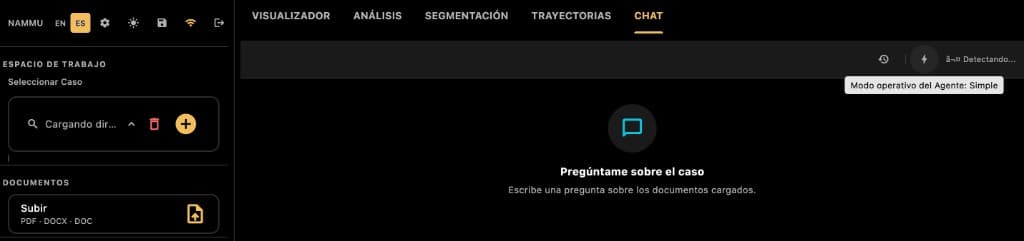
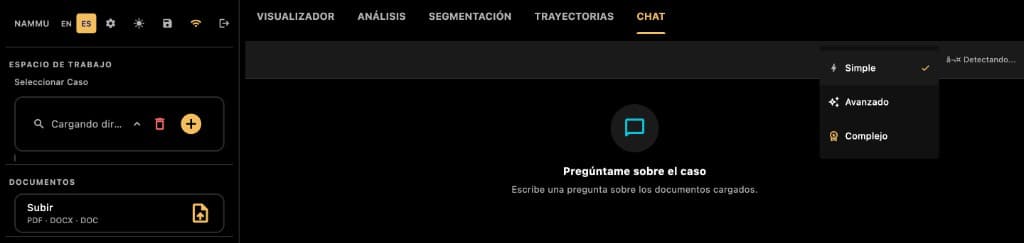
Your choice is remembered per workspace. Set Complex on a criminal matter and Simple on a fleet of traffic boletas, and each workspace keeps its own setting while you switch between them. The setting resets to Simple when the app restarts.
Jurisprudence questions always go to Complex (by default). When Nammu detects that you are asking about case law, it routes to the Complex cluster regardless of the selected mode. Case law is where a weaker model does the most damage.
Where the rollout stands. The mode selector is available first to our beta-testing lawyers. They are testing whether the three clusters are well chosen and whether the quality difference is real and noticeable. Paid plans currently run chat on the Advanced cluster, which is unchanged from before. Long term, we would like Nammu to infer the right cluster from each question, and we will build that only once beta testers’ results support it.